Free toolbox talk template, plus 30 Australian topics
Topic, what was covered, what the crew raised, actions with names against them, and a signed attendance list. Plus thirty topics so you are not inventing one at 6:50am.
Toolbox talk record
PDF, 1 page, A4 and Excel · Free · No email required
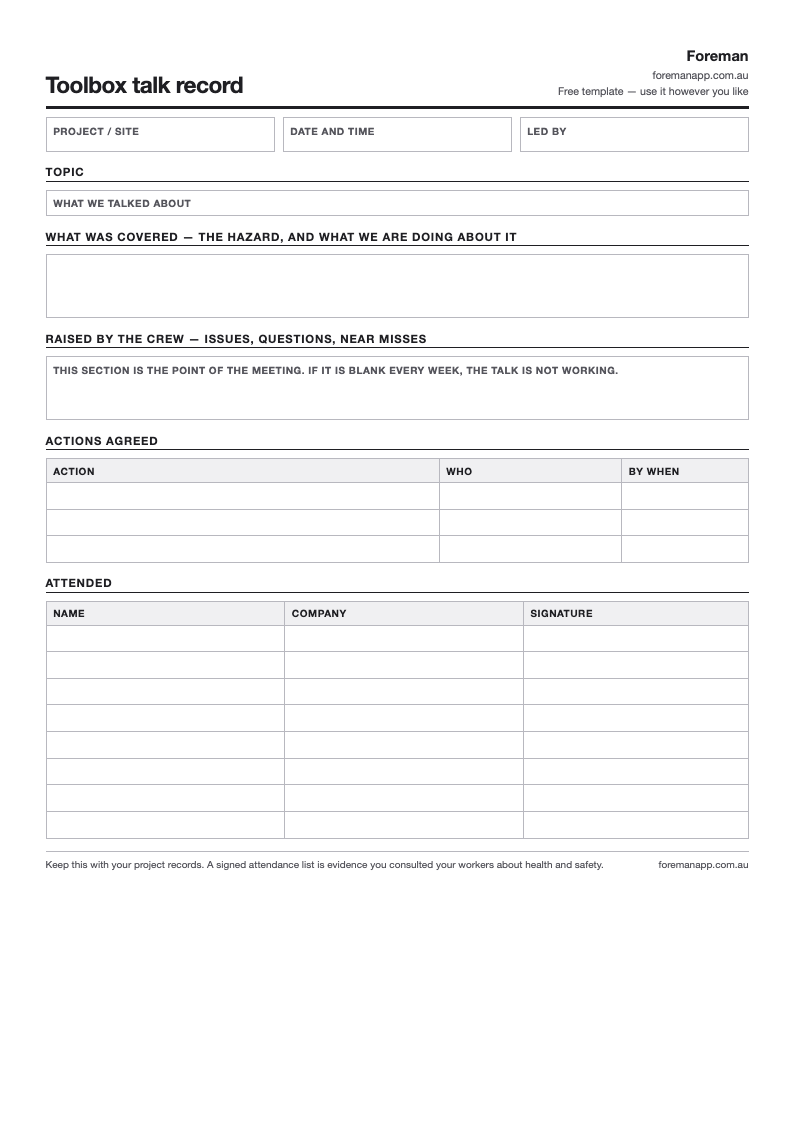
A one-page record for a toolbox talk: the topic, what you covered, what the crew raised, actions agreed with names against them, and a signed attendance list. Plus thirty Australian topics further down, so you are not inventing one at 6:50am.
Free, no email required.
Why the record is worth keeping
Consulting workers on health and safety is a legal duty, not a nice-to-have. Safe Work Australia is direct about it: consultation "is also a legal requirement", and a person conducting a business or undertaking must consult workers when identifying hazards, assessing risks and deciding how to manage them.
The useful part for a small builder is what comes next. Safe Work Australia says there is no set way consultation must occur, and that "for smaller workplaces with few workers, it might be as simple as regularly talking to workers about health and safety matters." It then names the mechanism directly: consultation "can also occur through usual communications, like team meetings and toolbox talks."
So the toolbox talk is not a box-ticking ritual invented by a safety consultant. It is one of the ways the regulator says a small business can meet a real duty. The signed attendance sheet is how you show it happened.
The approved Construction Work Code of Practice goes further and tells you what to keep. It describes as best practice keeping "a record of the topic covered, attendees and any feedback received", organising a program of talks so workers get a real opportunity to contribute, and monitoring whether the talks are actually changing anything. An approved Code is not law, but it is admissible in proceedings as evidence of whether a duty has been complied with, which makes that list worth following exactly.
Which is why this template has three fields most do not: what the crew raised, the actions agreed, and who attended.
The section that decides whether it works
Look at the template. There is a box titled "raised by the crew".
That box is the entire point of the meeting, and on most sites it is empty every week. A toolbox talk where the builder talks for four minutes and nobody says anything is a monologue with signatures on it. It satisfies nobody, least of all an inspector.
The things you want to hear are the ones you cannot see from your own position: the loose board on the scaffold, the extension lead that keeps tripping the RCD, the fact that the crane is booked the same morning as the concrete. Your crew know these things. Whether they mention them depends almost entirely on whether the last person who mentioned something got a result.
Which is why the actions row has a name and a date in it. One action, closed out by the date, does more for the next talk than any topic you could pick.
Running one that people do not resent
Five minutes, standing, at the start of the day. Not seated, not after smoko, not fifteen minutes.
One topic, and make it today's topic. Pick the thing that is actually happening on this site this week. If the roof goes on Thursday, talk about working at heights on Wednesday, not about hydration because it was next in the folder.
Talk about the site, not the subject. "Falls from height" is a subject. "That edge on the first floor, the one with no handrail yet, and what we are doing about it before Thursday" is a talk.
Ask, then wait. Ask what they have noticed, then stay quiet long enough to be uncomfortable. The first answer usually arrives about four seconds after you would normally have moved on.
Write down what was said, not just the topic. "Discussed working at heights" is worthless in six months. "Josh raised the temporary handrail at the stair void, agreed Aaron installs before Thursday's roof work" is a record.
Thirty topics that suit Australian residential sites
Work through these rather than inventing one each week.
Site conditions: heat and hydration on hot days · sun exposure and UV · wet weather access and slip hazards · wind and unsecured materials · dust and silica when cutting · noise and hearing protection
Access and heights: ladder placement and the three-point rule · working from a step platform · scaffold checks before use · penetrations and voids · roof edge protection · fragile roof surfaces
Plant and tools: power tool checks before use · leads, RCDs and testing · nail gun safety · angle grinder discs and guarding · excavator and truck movements on site · reversing and spotters
Materials and manual work: manual handling and team lifts · stacking and storing materials · sheet material in wind · working around a live trench · asbestos awareness in renovation work · underground and overhead services
People and process: new workers on site this week · what to do if you find something unsafe · incident and near miss reporting · first aid and who the first aider is · emergency procedure and assembly point · housekeeping and trip hazards · neighbours, driveways and public interface
Doing it without the folder
The paper record works. Keeping five years of paper records across four jobs does not.
Foreman's forms let you build a toolbox talk template once, using the headings above, and then your crew fill it in on their phone against the job. Submissions land in one place for the admin, with the date, so the question of what safety consultation you have actually done has an answer that does not involve a shed and a box of paper.
You build the template yourself, which sounds like work and takes about ten minutes. The form builder has the pieces this record actually needs: a checklist for what you covered, a photo field, and signature fields for attendance. The upside is that it ends up matching how you run a talk, rather than a generic form someone else wrote.
Related
The free site induction record covers the conversation you have with someone on their first day, and the site diary template has a tick box for whether a toolbox talk was held that day.
Sources
Every regulatory statement on this page traces to one of these. We recheck them when we update the page.
- Consultation — Safe Work Australia. Checked 25 August 2026.
- Construction work Code of Practice — SafeWork NSW. Checked 25 August 2026.