Free site diary template for Australian builders
One page, covering a full day on a residential or small commercial site. Print a stack for the ute, or work through the same headings on your phone.
Daily site diary template
PDF, 1 page, A4 and Excel · Free · No email required
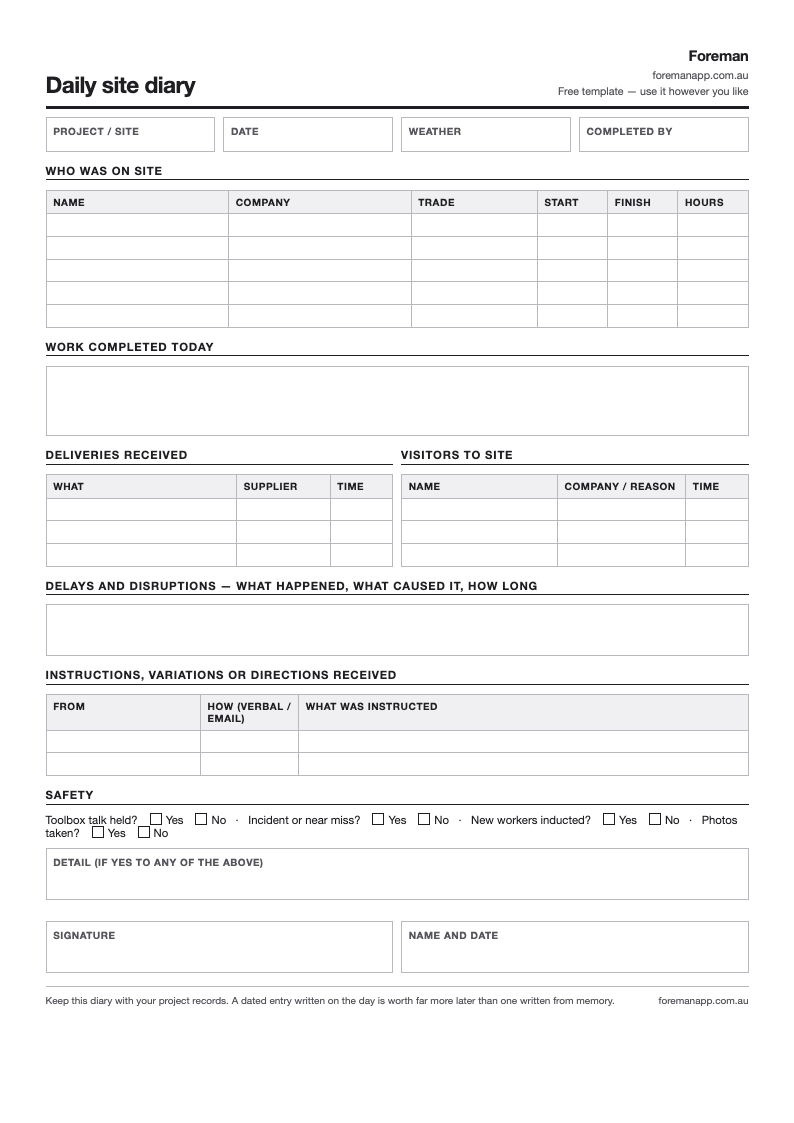
This template covers a full day on a residential or small commercial site: who turned up, what got built, what turned up late, what went wrong, and who told you to change something. One page. Print a stack and leave them in the ute, or work through the same headings on your phone.
Two formats: a print-ready PDF for the ute, and an Excel version if you would rather fill it in on a laptop or adapt the columns.
Both are free. No email, no signup, nothing gated.
What goes in each section
Who was on site. Name, company, trade, start, finish, hours. Do this by person, not by company. When a subbie invoices for eleven hours and your diary says he arrived at ten, you want the row, not a memory.
Work completed today. Write what was actually finished, not what was planned. "Second fix rough-in, kitchen and both bathrooms" beats "plumbing". Six months from now the detail is the whole point.
Deliveries received. What arrived, from whom, what time. This is the section that settles arguments with suppliers, and it takes ten seconds.
Visitors to site. The building surveyor, the client, the engineer, the bloke from the energy provider. Anyone who is not your crew or your subbies.
Delays and disruptions. What happened, what caused it, and how long you lost. Rain, a late delivery, waiting on an inspection, a service that was not where the plans said. This is the single most valuable section in the diary and the one most people skip.
Instructions, variations or directions. Who told you, how they told you, and what they said. Verbal instructions on site are the ones that vanish. Writing down "client asked to move the laundry door, verbal, on site" the day it happens is worth more than any argument you will have about it later.
Safety. Four tick boxes: toolbox talk, incident or near miss, new workers inducted, photos taken. Then a box for detail if you ticked yes to any of them.
The sections builders skip, and regret
Delays and instructions. Every time.
Work completed feels like the important bit because it is the visible bit. But nobody ever pulls out a site diary to prove that the frame went up. They pull it out because there is a dispute about time or about money, and both of those live in the delays section and the instructions section.
If you write nothing else on a bad day, write what stopped you and who told you to do something different.
Write it on the day
A diary entry written on the day carries weight. One reconstructed three weeks later from memory and a camera roll does not, and it reads that way to anyone assessing it.
The practical version of this rule: fill it in before you leave site, not at the kitchen table on Sunday. Two minutes at the gate beats an hour on the weekend, and it is more accurate.
Getting the same thing without the paper
The template works. The problem with paper is not the form, it is what happens to it: the folder lives in the shed, the shed is on one job, and you are running four.
Foreman's site diary does the same job from your phone. You pick the project, pick the crew member, log hours, write what happened and attach photos taken in the app. Deliveries, delays and instructions go in the same daily note. Every entry is dated, attached to the right job, and the project's diary exports as a CSV when a client or a head contractor asks.
The free plan covers one project, so you can run a job on it before you decide anything.
Related
If you want the legal side rather than the practical one, read is a site diary legally required in Australia. If you are chasing a daily report format for a head contractor, this same template covers it, since "site diary" and "daily report" describe the same document in Australian practice.