Free defect list template for Australian builders
One line per defect, fourteen rows to a page, landscape so it works on a clipboard. Australian terminology and Australian stages.
Defect list template
PDF, 1 page, A4 landscape and Excel · Free · No email required
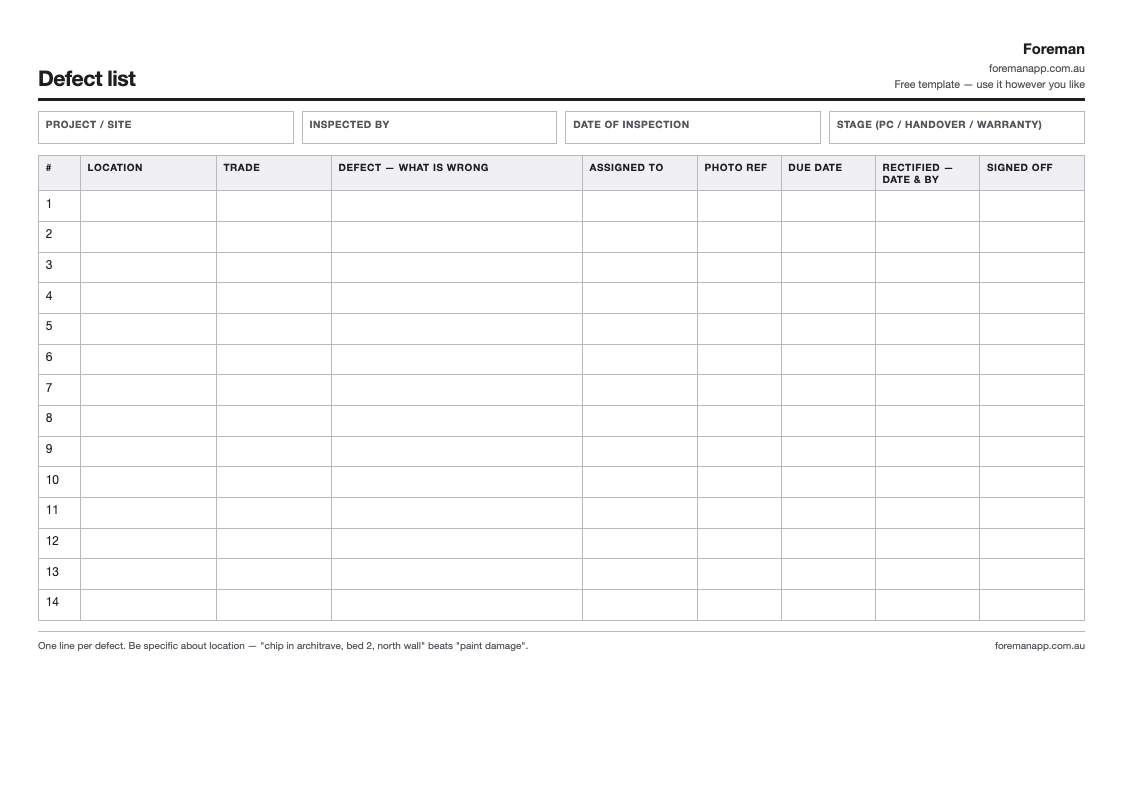
One line per defect: where it is, which trade owns it, what is wrong, who it is assigned to, when it is due, and when it was signed off. Fourteen rows to a page, landscape, so it fits on a clipboard and survives a walk-through.
Free, no email required.
Defect list, defecting, punch list, snag list
Same document, different words, and the words matter here because most of what you find online is American.
In Australia you are usually defecting a job, and the output is a defect list. A head contractor might call it a defects schedule. American software calls it a punch list. British and Irish sites call it a snag list. If you have been searching for a punch list template and getting results that reference AIA contracts and OSHA, that is why.
This one uses Australian terminology and Australian stages: practical completion, handover, and the warranty or defects liability period afterwards.
What goes in each column
Location. The single most important column, and the one people rush. "Bed 2, north wall, beside the window" gets fixed on the first visit. "Bedroom" gets a phone call, a second trip, and an argument about which bedroom.
Trade. Who owns it. Sort by this column before you send anything out, so each subbie gets their own list rather than the whole schedule with their items scattered through it.
Defect. What is actually wrong, in the fewest words that leave no ambiguity. Write the fault, not the fix. "Architrave chipped, 300mm from floor" is a defect. "Replace architrave" is you doing the trade's job for them and taking on the argument about whether it needed replacing.
Assigned to. A person, not a company. Companies do not fix things, people do.
Photo ref. Number every photo and put the number here. A defect list with photos gets closed out at roughly twice the speed of one without, because nobody has to interpret your handwriting.
Due date. Per item. A single blanket deadline for forty defects means everything arrives on the last day or not at all.
Rectified, and signed off. Two separate columns on purpose. Rectified is the trade saying they have done it. Signed off is you confirming they have. Collapsing those two into one column is how defects get closed that were never actually fixed.
Write it so it gets fixed once
The test for every line: could someone who was not on the walk-through find this defect and know when it is resolved, without ringing you?
Three habits that get you there.
Be specific about position. Rooms, walls, heights, distances. "Second bedroom, north wall, 300mm above skirting."
Describe the fault, not your opinion of it. "Paint finish uneven over 400mm" rather than "bad paint job". The first is a fact that can be inspected. The second is an argument.
Photograph every single one. No exceptions, even the obvious ones. The photo is what stops the conversation about whether it was like that before.
Do the walk in one pass
Do not start fixing things while you are inspecting. It ruins the list and doubles the time.
One pass, room by room, in the same order every time so you stop skipping rooms. Number as you go. Photograph as you go. Then sit down and sort by trade afterwards.
If you are handing over to a client, do your own defecting pass first, a day or two before theirs. Everything you find and fix in advance is an item that does not appear on their list, and clients judge a handover by the length of their own list.
The same thing without the clipboard
The paper list works fine on the day. It falls down over the fortnight after, when items are half fixed, three subbies are involved, and the only current version is the one in your ute with things crossed out.
Foreman's tasks handle defects as assigned work: write the defect, assign it to one person, and see what is still open across every job without ringing anyone. It is deliberately simple, one tickable line per defect, so nothing needs explaining to a subbie. Photos go in against the project, either as a straight upload or attached to that day's diary entry, so the visual record sits with the job rather than on someone's phone.
Two things worth knowing. Tasks do not carry a due date field, so if dates matter to how you run a list, keep using the sheet above for that column. And if you want the walk itself captured, with a checklist and photos against each item, build it as a form instead of a task; forms take checklists, photos and signatures, while a task is deliberately just one line to assign.
Related
The free site diary template covers the daily record during the build, and how to keep a site diary covers the habit that means you can prove when work was done.